Units, regions, and weighing styles
How recipes.im handles cups vs grams, US vs Australian tablespoons, and when we weigh solids vs measure them by volume.
Cooking units are messier than they look. A US tablespoon is 14.79 ml. A UK tablespoon is 15 ml. An Australian tablespoon is 20 ml. "1 cup of flour" means a different number of grams in different cookbooks. We try to make all of this disappear into a few household-level settings under Units and conversion.
Unit system: metric, imperial, or as authored
Open the household menu → Units and conversion. Three options:
- Metric — every recipe renders in grams, milliliters, and Celsius. Cups and ounces are converted on the fly.
- Imperial — every recipe renders in cups, ounces, tablespoons, and Fahrenheit.
- As authored — we leave each recipe in whatever units the original cook used. Some metric, some imperial, depending on where you got it.
Conversion happens at render time, not when you import. The recipe's underlying .cook file stays as it was authored — flip the preference and every recipe in your library re-renders instantly. No re-parse, no data loss.
Temperature: C, F, gas mark, or as authored
Decoupled from the unit system because the UK uses metric volumes but Celsius for ovens, and US bakers sometimes ask for Fahrenheit even on metric recipes. The four options work the same way as units — as authored keeps the recipe's original choice.
Regional tablespoons (and the Australian trap)
Most cookbooks don't tell you which tablespoon they mean. We pick based on your region preference:
- US — 14.79 ml
- UK — 15 ml
- Australia — 20 ml
- Metric (default) — 15 ml
Weighing style: when do solids show in grams?
Three presets in the preferences sheet, mapped to the recipe-parser's modality engine:
- Volume only — solids stay in cups and tablespoons regardless of size. Most US home cooks.
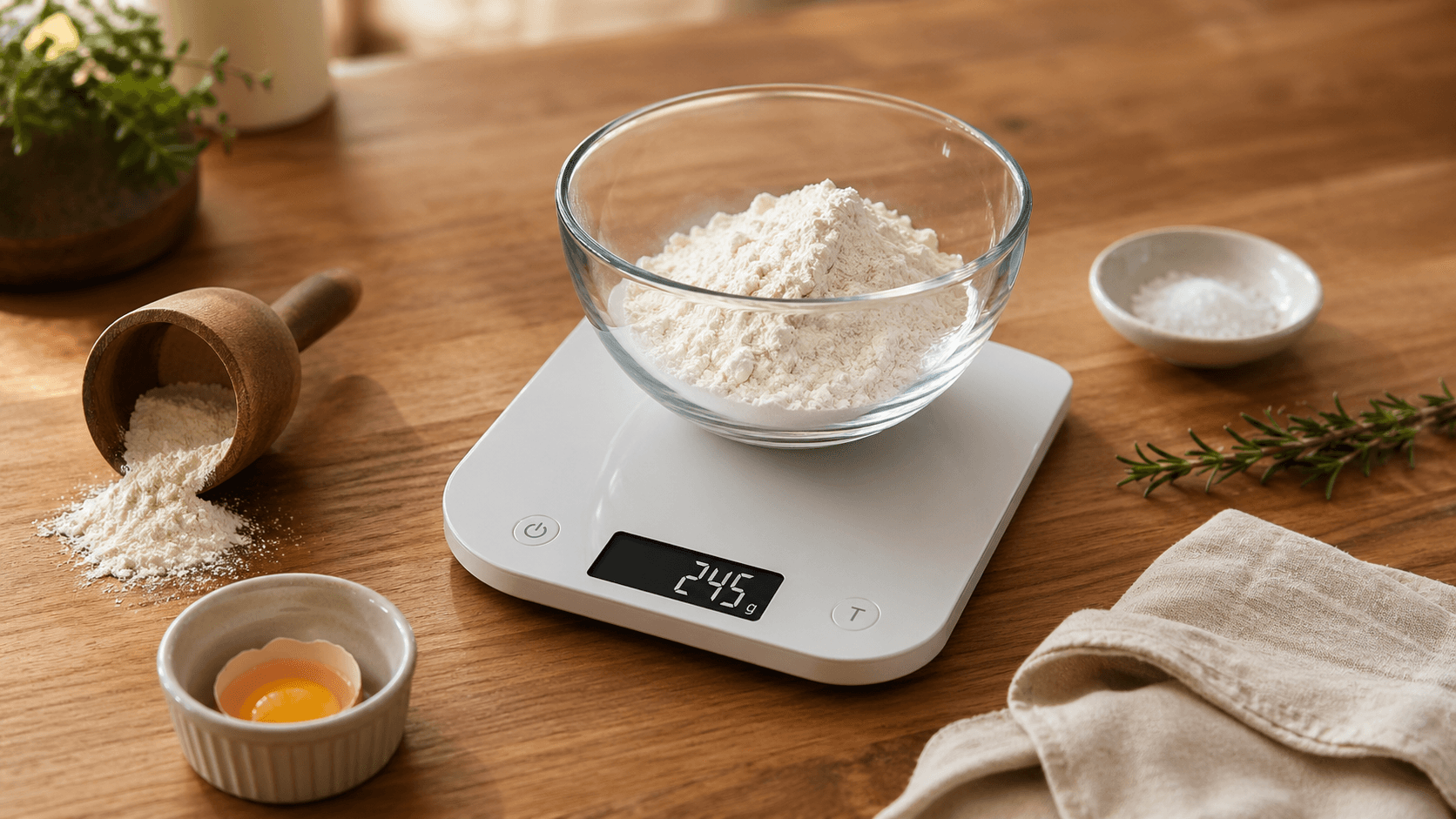
- Weigh solids when over 2 tbsp — small amounts (a teaspoon of paprika) stay volumetric; bigger amounts (1 cup of flour) convert to grams. Best for serious bakers who want precision on the bulk ingredients.
- Weigh solids and liquids both — almost everything in grams or milliliters. Pro-kitchen mode. Spices stay volumetric below 2 tbsp because no one weighs ¼ tsp of cinnamon.
Number style: fractions or decimals
Cups and tablespoons render as 1 ½ (default) or 1.5 (if you flip the preference). Grams and milliliters always render as decimals — there's no fractional-gram convention in cooking.
Why we don't always convert volume to weight
Every flour, sugar, or oil has a density — 1 cup of all-purpose flour is roughly 120 g. "Roughly" is the catch: weights vary by 15-25% between scoop-and-sweep and spoon-and-level methods, by humidity, by brand. We have a curated density table that's good enough for single-recipe display when your weighing preference asks for grams.
But we never bridge volume and weight when aggregating shopping lists. Three recipes calling for 1 tsp salt show up as 3 tsp salt, not ~18 g salt — see the Ingredients guide for the full reasoning.
What about gas marks?
British and Australian gas ovens don't use degrees — they use a numbered scale where Mark 1 is ~140°C and Mark 9 is ~245°C. If you set the temperature preference to Gas mark, oven temps render as Gas Mark 6 etc.
Related guides
How recipes.im handles serving size scaling — and why some ingredients are intentionally fixed, marked with an orange chef hat.
Categorization, quantity merging, pluralization, and why your shopping list keeps cups separate from grams.
How recipes.im households work — invite codes, shared libraries, and the per-household units-and-conversion settings that drive scaling and grocery aggregation.